How Millennial Buyers Are Reshaping Middle Tennessee Real Estate
Navigating the Shifting Demographics:
The face of homeownership in Middle Tennessee is changing. Millennials—now ages 28 to 43—have reached their peak earning and home-buying years, and they’re fundamentally reshaping the real estate landscape in Franklin, Brentwood, Spring Hill, Thompson’s Station, Columbia, and Nashville. Understanding what drives this massive demographic is essential for anyone buying, selling, or investing in Middle Tennessee real estate in 2026 and beyond.
The Millennial Moment: Why Now?
After years of delay caused by student debt, the 2008 financial crisis, and rising home prices, millennials have finally arrived as the dominant force in real estate. The numbers tell a compelling story:
Key Statistics:
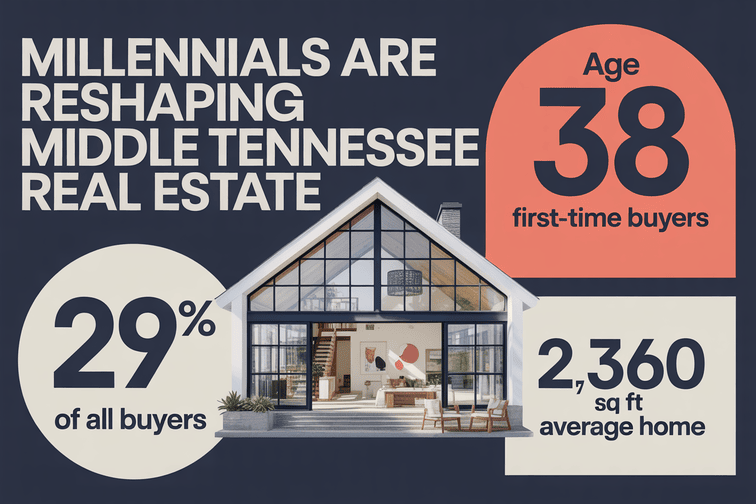
- 29% of all homebuyers are millennials—the largest generational cohort in the market
- Median age of first-time buyers: 38 years old—nearly a decade older than previous generations
- 71% of younger millennials (26-34) and 36% of older millennials (35-44) are first-time buyers
- 78% hold bachelor’s degrees or higher—the most educated home-buying generation in history
What makes 2026 particularly significant is the convergence of several factors:
- Millennials entering peak earning years (mid-30s to early-40s)
- Moderating mortgage rates (forecast to reach 5.9-6.2% by late 2026)
- Improving housing inventory (up 15%+ year-over-year in Tennessee)
- Remote work flexibility enabling geographic choice
- Growing families create urgency for space and stability
What Millennial Buyers Want: Priorities That Shape the Market
Millennial preferences are dramatically different from previous generations, and their priorities are reshaping everything from architectural styles to community amenities in Middle Tennessee.
1. Size Matters—But Not How You Think
Contrary to the “tiny home” stereotype, millennials are buying LARGER homes than any other generation:
- Younger millennials (26-34): 2,200 square feet median
- Older millennials (35-44): 2,360 square feet median
- Gen X and Boomers: 2,000 square feet or less
Why the size difference? Millennials delayed homeownership until they’re starting or growing families, working from home, or both. They’re skipping the “starter home” phase and going directly to the home that accommodates their full lifecycle needs.
Middle Tennessee implication: This drives strong demand in Spring Hill, Thompson’s Station, and Columbia, where newer construction delivers the square footage millennials seek at achievable price points. Franklin and Brentwood’s larger estate homes also appeal to established millennial professionals.
2. The Modern Farmhouse Phenomenon
Walk through any newer development in Thompson’s Station or Spring Hill, and you’ll see the architectural preferences millennials have popularized: modern farmhouse and craftsman styles dominate the landscape.
What they’re seeking:
- Open-concept floor plans for entertaining and family interaction
- Primary bedroom suites on the main level
- Large kitchen islands functioning as the home’s social hub
- Outdoor living spaces (covered patios, built-in grills)
- Mudrooms and functional entry spaces
- Home offices (a pandemic-accelerated must-have)
Design features they avoid:
- Formal living and dining rooms (seen as wasted space)
- Closed-off kitchens
- Carpeted bedrooms
- Builder-grade finishes
- Dated color schemes (especially orange oak and brown granite)
Middle Tennessee builders have responded: New construction in Thompson’s Station, Spring Hill, and even renovated properties in Franklin increasingly reflect these preferences, driving demand and commanding premium pricing.
3. Technology Integration Isn’t Optional
Having grown up digital, millennials expect smart home technology as standard, not luxury:
- Smart thermostats, security systems, and doorbell cameras
- Integrated home automation (lighting, shades, entertainment)
- High-speed internet infrastructure (fiber connectivity is a major selling point)
- EV charging capability or infrastructure-ready garages
- Energy-efficient HVAC, windows, and insulation (both environmental and cost savings)
Franklin and Brentwood’s challenge: Older homes require retrofitting. Sellers who invest in smart home upgrades and energy-efficiency improvements capture millennial buyers’ attention.
Spring Hill and Thompson’s Station’s advantage: New construction includes these features as standard, making these communities particularly appealing to tech-savvy millennial buyers.
4. Walkability and Community—Within Reason
While millennials value walkability more than previous generations, they’re not necessarily choosing urban density in Middle Tennessee. Instead, they’re seeking communities that recreate walkable elements within suburban settings:
What’s resonating in Middle Tennessee:
- Tollgate Village in Thompson’s Station: Walkable shopping and dining within a suburban community
- Downtown Franklin: Historic walkability with suburban access
- Cool Springs/Brentwood: Mixed-use developments with retail, dining, and offices
- Spring Hill’s Town Center developments: Creating walkable nodes within auto-oriented suburbs
The pattern: Millennials want the option to walk to coffee, a restaurant, or a park—but they still rely on cars for most activities. Communities offering both connectivity and convenience win.
5. Prioritizing Experience Over Status
Unlike Boomers, who valued prestige addresses, millennials prioritize experiences and lifestyle:
- Proximity to entertainment, dining, and cultural activities
- Access to outdoor recreation (parks, greenways, trails)
- Community events and social connectivity
- Pet-friendly communities and amenities
- Breweries, local coffee shops, and unique dining (not just chains)
Middle Tennessee winners: Franklin’s vibrant Main Street, Spring Hill’s growing restaurant scene, and even Columbia’s revitalized downtown square align with these preferences. Communities investing in lifestyle amenities rather than just housing stock are capturing millennial buyer loyalty.
The Millennial Financial Reality: Challenges and Adaptations
Understanding millennial buyers means understanding their unique financial pressures and how they’re adapting:
Student Debt’s Lingering Shadow
The numbers are sobering:
- 43% of younger millennials carry student loan debt with a median balance of $30,000
- 29% of older millennials still have education debt, averaging $35,000
- Many delayed homeownership for years while paying down debt
Impact on the Middle Tennessee market:
- Drives demand for value markets like Columbia ($350K median) and Spring Hill ($495K median)
- Creates urgency to “catch up” once debt is manageable, leading to willingness to stretch budgets
- Explains why millennials are buying at 38 instead of 28—they needed the decade to prepare financially
Down Payment Creativity
Millennials are resourceful when it comes to down payments:
- 33% of younger millennials receive down payment gifts from family members
- Many leverage THDA’s Great Choice loan programs (3.5-0% down with assistance)
- Others tap into 401(k) loans or first-time buyer programs
- Remote work enabled some to sell in expensive markets and buy in Tennessee with substantial equity
What this means for sellers: Don’t dismiss offers with lower down payments or gift funds. These buyers often have strong income and can secure financing—they’re just using creative (and legitimate) paths to homeownership.
The Spending Trade-Off
To afford homes, millennials are cutting elsewhere:
- 70% cut spending on luxury items and entertainment
- Many delay other major purchases (cars, weddings, children)
- Prioritizing homeownership over traditional status symbols
The urgency driver: After years of delay, millennials view homeownership as essential to building wealth and stability—making them motivated buyers willing to compromise in some areas to achieve their goals.
How Millennials Search and Buy: The Digital-First Generation
The millennial home search looks radically different from previous generations:
The Digital-First Journey
Stage 1: Self-Directed Research (Weeks to Months)
- Starting with online searches (Zillow, Redfin, Realtor.com)
- Deep dives into neighborhood research (schools, crime, walkability scores)
- Virtual tours and 3D home models
- Social media research (neighborhood Facebook groups, local Reddit threads)
- YouTube tours of communities and homes
Stage 2: Expert Partnership (When Ready to Act)
- Reaching out to agents only after extensive research
- Expecting agents to provide insights BEYOND what’s available online
- Valuing market knowledge, negotiation expertise, and transaction management
- Instant communication expectations (text and email preferred over phone calls)
What this means for The Gillig Group: Millennials arrive informed—your value lies in deeper local knowledge, negotiation strategy, and smoothing the transaction process, not basic property information.
Speed and Decisiveness
Paradoxically, millennials research extensively but act quickly once ready:
- Average younger millennials view just six homes before buying
- Search length averages 8 weeks (shorter than previous generations)
- When they find “the one,” they move fast
Market implication: Homes that meet millennial criteria (size, style, location, price) sell quickly. Well-presented properties in Thompson’s Station, Spring Hill, and Franklin’s newer developments often receive multiple offers from millennial buyers.
The Inspection and Negotiation Approach
Millennial buyers approach negotiations differently:
- More likely to request repairs rather than price reductions
- Focus on functional issues (HVAC, roof, foundation) over cosmetic issues
- Less emotional, more analytical in their decision-making
- Willing to walk away if inspection reveals dealbreakers
- Expect transparency and data-backed responses from sellers
Geographic Preferences: Where Millennials Are Landing in Middle Tennessee
Millennial settlement patterns in Middle Tennessee reveal clear preferences:
The Primary Markets
Spring Hill: The Millennial Magnet
- Why it works: Newer construction (most homes post-2000), median price around $515K, modern floor plans, growing amenities
- The appeal: Hitting the sweet spot of affordability and newness; large lots; family-friendly
- The demographic: Young families, dual-income couples, first-time move-up buyers
- Average buyer age: 33-38
Thompson’s Station: Modern Suburbia Realized
- Why it works: Predominantly new construction, Tollgate Village walkability, excellent schools
- The appeal: Everything is new and designed with millennial preferences in mind; modern farmhouse aesthetic everywhere
- The demographic: Established professionals, growing families prioritizing schools
- Average buyer age: 36-40
- The trade-off: Higher prices ($750K-$850K) but getting exactly what they want
Franklin: Urban-Suburban Hybrid
- Why it works: Walkable downtown, strong job market, excellent schools, cultural activities
- The appeal: Feels established but vibrant; history + modernity; downtown lifestyle with suburban spaces.
- The demographic: Older millennials, dual high-income professionals, those prioritizing lifestyle
- Average buyer age: 38-42
- The reality: Premium pricing ($800K-$900K) limits accessibility but draws established millennials
Columbia: Value-Conscious Choice
- Why it works: True affordability ($350K median), improving downtown, space for the money
- The appeal: Can buy significantly more home; easier to achieve homeownership
- The demographic: First-time buyers, single-income families, those prioritizing space over prestige
- Average buyer age: 32-36
- The consideration: Longer commute, Maury County schools vs. Williamson County schools
The Overlooked Opportunities
Brentwood: The Established Millennial Market. While often associated with older, wealthier buyers, Brentwood is seeing an influx of older, high-earning millennials:
- Tech executives, healthcare professionals, and successful entrepreneurs
- Willing to pay a premium ($1.2M+) for top schools and established neighborhoods
- Often relocating from expensive markets (California, New York) with significant equity
- Represent the “peak millennial” buyer—highest earning years, established careers
Nashville Proper: The Urban Holdouts Some millennials still prefer Nashville’s urban core despite cost:
- Child-free couples or small families
- Those working downtown or prioritizing nightlife/culture
- Condo and townhome buyers are accepting smaller spaces for location
- Typicall,y higher-income dual-professional households
The Millennial Impact: How They’re Changing Communities
Beyond individual home purchases, millennial settlement patterns are reshaping communities:
Retail and Dining Evolution
Communities are adapting to millennial preferences:
- More: Local coffee shops, breweries, farm-to-table restaurants, fitness studios
- Less: Big-box retail, chain restaurants, traditional malls
Examples in Middle Tennessee:
- Thompson’s Station’s Tollgate Village: Walkable district with local businesses
- Spring Hill’s dining scene: Expanding beyond chains to include local gastropubs and breweries
- Franklin’s Main Street: Continued investment in unique retail and dining experiences
- Columbia’s town square: Revival driven by younger residents seeking authenticity
Community Amenities Shifting
HOAs and developers are responding to millennial demands:
- Rising: Dog parks, greenways, community gardens, playground investments
- Static: Golf courses (less important to millennials), tennis courts, formal clubhouses
- Emerging: Co-working spaces within communities, electric vehicle charging stations, fiber internet as standard
Political and Social Engagement
Millennials are more civically engaged than expected:
- High attendance at planning and zoning meetings
- Advocacy for walkability, environmental sustainability, and schools
- Pushing for diverse housing options (townhomes, small-lot homes, not just large single-family)
- Supporting local businesses and community events
The result: Communities are becoming more dynamic, with younger residents pushing for progressive planning while valuing the suburban lifestyle they chose.
Selling to Millennials: What Works (and What Doesn’t)
If you’re selling a home in Middle Tennessee, understanding millennial preferences is critical:
What Captures Millennial Attention
- Professional Photos and Virtual Tours
- Absolutely non-negotiable; millennials won’t even visit without quality photos
- 3D virtual tours (Matterport) dramatically increase showing requests
- Drone footage for properties with acreage or compelling exterior views
- Neutral, Modern Finishes
- White/gray cabinets, quartz countertops, contemporary fixtures
- Hardwood or luxury vinyl plank flooring (NO carpet except bedrooms)
- Fresh paint in grays, whites, and subtle earth tones
- Updated light fixtures (recessed lighting, modern pendants)
- Functional Spaces
- Home office setup or obvious office potential
- Primary bedroom suite (even better if on main level)
- Open kitchen with large island
- Mudroom or drop zone
- Pantry (walk-in preferred)
- Outdoor Living
- Covered patio or deck
- Level, usable yard
- Privacy (fencing or natural screening)
- Low-maintenance landscaping
- Smart Home Features
- Smart thermostat, doorbell camera, locks
- Wired for home automation
- Energy-efficient appliances and systems
- EV charging or a dedicated 240V outlet
What Turns Millennials Away
- Deferred Maintenance
- Dated HVAC systems, old roofs, and worn carpets signal expense
- Millennials are busy; they want move-in ready or minor updates only
- Dated Aesthetics
- Formal living/dining rooms
- Closed-off kitchens
- Popcorn ceilings, wallpaper, and outdated tile
- Builder-grade brass fixtures and hardware
- Dark, heavy interiors
- Poor Online Presentation
- Low-quality photos, limited photos, or no virtual tour
- Vague or poorly written descriptions
- No information about smart home features, energy efficiency, or recent updates
- Location Limitations
- Busy roads without privacy
- Far from amenities (groceries, dining, entertainment)
- Poor school ratings
- Limited internet options (a dealbreaker for remote workers)
Pricing Strategy for Millennial Buyers
Be Strategic:
- Price competitively from day one; millennials research extensively and know market value
- Overpricing backfires—homes sitting on the market lose millennial attention
- Highlight value: cost per square foot, recent updates, and included features
Consider:
- Offering buyer incentives (closing cost assistance, rate buy-downs through preferred lenders)
- Flexibility on closing dates (millennials often coordinate with leases or remote work transitions)
- Including smart home devices, appliances, or other features that resonate
The Millennial Investor: A Growing Force
It’s not just homeownership—millennials are also entering the investment property market:
The Millennial Landlord Profile
- Often house-hacking (living in one unit, renting others)
- Purchasing second properties as long-term rentals
- Focused on cash flow and appreciation (not just appreciation)
- Prefer turnkey properties or cosmetic renovations only
- Leverage online tools for tenant screening and rent collection
Middle Tennessee appeal for millennial investors:
- Strong rental demand across all price points
- Multiple universities and corporate growth are driving the tenant base
- Relative affordability compared to coastal markets
- Tennessee’s landlord-friendly laws
Investment Patterns
Entry-level investment markets:
- Columbia: Strong cash flow potential, lower entry cost
- Spring Hill: Growing employment base, newer rentals in demand
- Antioch/South Nashville: Urban rental demand, lower acquisition cost
Premium investment markets:
- Franklin: Short-term rental potential, corporate executive rentals
- Brentwood: High-income professional tenant base
- Thompson’s Station: Family rentals in excellent school districts
Looking Ahead: 2026 and Beyond
The millennial impact on Middle Tennessee real estate will only intensify:
Continued Dominance
- Next 5 years: Millennials remain the largest buyer cohort
- Older millennials (40-44): Moving into peak earning years, upgrading homes
- Younger millennials (28-33): Finally entering the market in larger numbers as they reach financial stability
Market Adaptations
Expect communities to continue evolving to meet millennial preferences:
- More mixed-use developments combining residential, retail, and office
- Continued emphasis on walkability within suburban contexts
- Smart community infrastructure (high-speed internet, EV charging)
- Smaller lot sizes with better design (not McMansions on large lots)
- Diverse housing types within communities (not just single-family)
Generational Wealth Transfer
As Baby Boomers age, millennials will inherit wealth—expect:
- Increased down payment capacity
- Move-up buying in premium markets
- Investment property purchases are accelerating
- Multigenerational living considerations (accommodating aging parents)
Technology Integration Deepens
Future millennial-oriented developments will feature:
- Full smart home integration as standard
- Fiber internet infrastructure throughout
- Community apps for resident communication and amenity management
- Sustainable building practices (solar, geothermal, net-zero capable)
Working with Millennial Buyers: Best Practices for Real Estate Professionals
Understanding millennial buyers requires adapting your approach:
Communication Preferences
Do:
- Text as primary communication method
- Respond quickly (within hours, not days)
- Use email for detailed information and contracts
- Leverage video calls for remote buyers
- Provide digital documents and e-signature options
Don’t:
- Call without texting first
- Expect phone calls as primary communication
- Delay responses waiting for “business hours”
- Print everything when digital works
Marketing That Resonates
Effective approaches:
- Strong social media presence showcasing local knowledge
- Video tours and community overviews
- Educational content (first-time buyer guides, market updates)
- Client testimonials (especially from other millennials)
- Transparency about process and costs
Ineffective approaches:
- Traditional advertising (newspaper, direct mail)
- Pushy sales tactics
- Lack of online presence
- Inability to provide data and market analytics
The Consultation Approach
Millennials respond to:
- Education and empowerment (help them understand, don’t decide for them)
- Data-driven recommendations (market analytics, comparable sales)
- Transparency about costs, timelines, and processes
- Respect for their research (they’ve done homework; acknowledge it)
- Partnership mentality (not “I’m the expert, trust me”)
Managing Expectations
Be Realistic About:
- Budget vs. wish list (help them prioritize)
- Market competition (especially in desirable millennial markets)
- Timeline (from search to close)
- Compromise necessity (perfect homes rarely exist)
Guide Toward Success:
- Pre-approval before house hunting
- Focus on must-haves vs. nice-to-haves
- Long-term thinking (not just the first home, but the 5-10 year plan)
- Understanding total cost of ownership
The Millennial Advantage: Why They’re Reshaping the Market for the Better
While often criticized, millennial homebuyers bring positive changes to Middle Tennessee real estate:
Higher Standards
Millennials demand quality:
- Pushing builders toward better design and construction standards
- Forcing sellers to maintain and update properties properly
- Raising expectations for energy efficiency and sustainability
- Emphasizing functionality and livability over show
Result: Overall housing stock improves as the market responds to their preferences.
Community Investment
Despite “transient” stereotypes, millennials invest in communities:
- Supporting local businesses over chains
- Participating in schools and local government
- Maintaining homes and properties
- Contributing to community character
Result: Communities becoming more vibrant and engaged.
Market Efficiency
Digital-first approach creates efficiencies:
- Faster transactions through technology adoption
- Better-informed buyers and sellers
- Reduced information asymmetry
- More transparent pricing
Result: Smoother transactions and a more functional market overall.
Diversity and Inclusion
Millennials are the most diverse generation:
- More interracial and multicultural families
- LGBTQ+ acceptance and inclusion
- Varied family structures (single parents, multi-generational, chosen family)
- International backgrounds and perspectives
Result: Communities are becoming more welcoming and diverse, enriching the social fabric.
Conclusion: Embracing the Millennial Shift
Millennials aren’t changing Middle Tennessee real estate capriciously—they’re responding to economic realities, technological capabilities, and evolved priorities. Understanding these drivers helps everyone navigate the market more successfully.
For Sellers: Recognize millennial preferences and prepare properties accordingly. Modern finishes, smart home features, and strong online presentation aren’t optional—they’re essential to capturing the largest buyer segment.
For Buyers: You’re not alone in your preferences and challenges. Understanding common millennial patterns helps you navigate the market with confidence and make informed decisions aligned with your goals.
For Communities: Embracing millennial preferences—walkability, sustainability, diverse housing types, local character—creates vibrant, resilient communities that benefit all residents.
For Real Estate Professionals: Adapting communication styles, marketing approaches, and service delivery to millennial expectations isn’t just good business—it’s necessary to remain relevant in a millennial-dominated market.
The millennial reshaping of Middle Tennessee real estate isn’t a temporary trend—it’s the new normal. Communities like Spring Hill, Thompson’s Station, Franklin, Brentwood, and Columbia that understand and respond to millennial preferences will thrive. Those who resist will struggle.
The question isn’t whether millennials will shape the market—they already are. The question is whether you’re ready to adapt, embrace, and succeed in this new reality.
Ready to Navigate the Market Successfully?
Whether you’re a millennial buyer searching for your first home, a seller preparing to list in a millennial-dominated market, or an investor seeking opportunities, The Gillig Group brings the local expertise and market knowledge to guide you toward success.
We understand that millennials aren’t just another demographic—they’re a generation with unique needs, preferences, and challenges. Our approach combines:
- Deep knowledge of the communities millennials prefer
- Understanding of millennial financial realities and creative solutions
- Digital-first communication and transaction management
- Data-driven recommendations and market insights
- Partnership mentality that respects your research and intelligence
Contact The Gillig Group today to discuss how we can help you successfully navigate Middle Tennessee’s millennial-shaped market—whether you’re buying your first home, selling to millennial buyers, or investing for the future.
The market is evolving. Your real estate partner should evolve with it.
Sources & Methodology: This analysis draws from National Association of Realtors data, local MLS statistics, U.S. Census data, and Middle Tennessee market trends through 2025. Demographic insights reflect national millennial homebuyer patterns as observed in Middle Tennessee markets. Individual experiences may vary.